
The Boring Stuff Is the Point
The parenting skill nobody teaches: staying present when your kid’s passion bores you to death.

My boys love cooking with me.
On a random Tuesday night we’ll cook fish tacos and make the tortillas from scratch. I love it.
Flour is everywhere. They stand on two stools next to the stove shoving one another for more space. They ask a thousand questions. They argue over whose turn it is to crack the eggs and inevitably drop shell into the bowl. I correct them sometimes. I lose my patience occasionally. But mostly, it works.
Cooking feels like shared ground.
I know what I’m doing. They feel included. There’s a rhythm to it. A sense that we’re all participating in something that makes sense to me and feels meaningful to them. (And we all get fed!) I’m not counting minutes till bedtime.
It’s connection that comes easily.
And for a long time, I think I assumed that’s just what connection was: mutual, enjoyable, and at least mildly productive. The kind that energizes rather than drains.
The Easy Version of Connection
On Monday, I was interviewing Ambitious Dad Maurice Philogene when he told me about how his son came down before school to watch football highlights, which surprised him because his son wasn’t a huge fan of the sport. When he reflected on it, Maurice realized his son had been doing it as a way to connect with him. He would watch the hightlights then jump into conversation about the Patriots game with Maurice at breakfast.
When he shared that, I felt that same warmth I feel cooking with my boys.
This is the easy version of connection: shared interests. They’re the places where connection doesn’t ask us to give up competence, control, or enthusiasm.
But this was just part one of a big insight Maurice and I discovered together.
Connection on Their Terms
Maurice and I ended up in a question that’s both funny and… weirdly exposing:
What about the things our kids love that absolutely bore us?
For him, it was Fortnite, and his son insisting that he watch him play it live (cue the snoring).
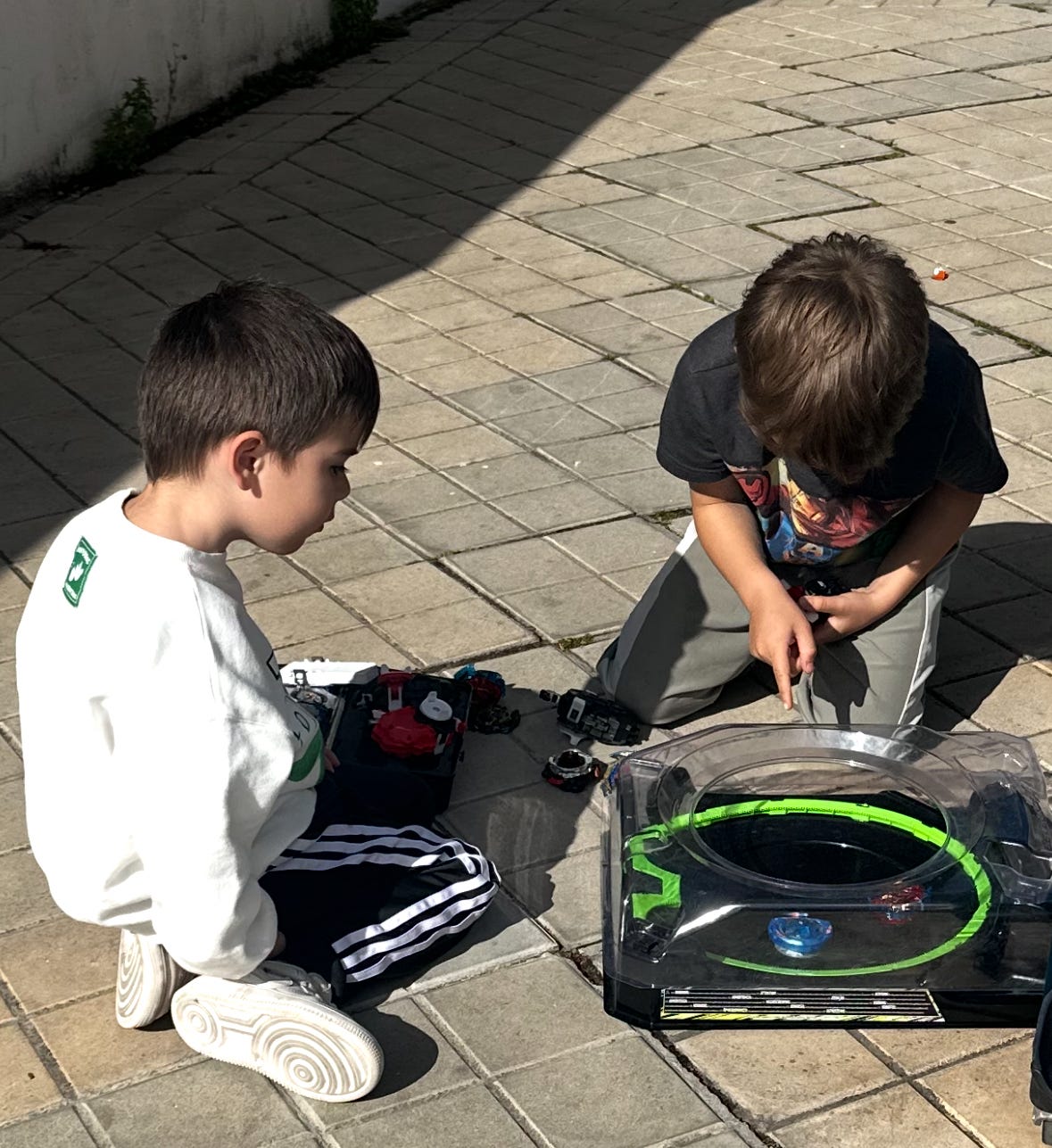
For me, it’s Beyblades, and endless conversations about small spinning tops that battle each other in plastic arenas (cue me nodding “uh huh” while reviewing my to do list in my head).
And this is where it got interesting, because buried inside the boredom was something kind of tender:
Our kids don’t only try to connect with us by stepping into our world. Sometimes they invite us into theirs.
The Part of Connection That Costs Something
I realized I’d been carrying an unspoken assumption:
If it’s real connection, it should feel good. It should feel mutual. It should feel like cooking.
But it doesn’t.
Sometimes connection feels like… being a background character in a K-Pop Demon Hunters sequel. Sometimes it feels like I’m being asked to care deeply about something I do not understand, do not enjoy, and did not consent to learning the rules of.
And if I’m honest, I assume our kids can feel the difference because “connection on their terms” asks something different of us. It asks us to enter their world not as teachers or curators, but as guests. To me that means: I don’t correct or help, nor redesign the furniture. I ask questions and follow the rules they mandate.
This is a different muscle, one that a lot of dads don’t realize they’re weak at until they try to use it.
As Ambitious Dad Tom Critchlow explained on my podcast, “it’s a lot harder to play with your kids than you think it is.”
Yes. Exactly. Because the hard part isn’t sitting on the floor, it’s the ego detox. I’ve got to go at their speed. I’m not driving the play. I can’t “optimize” it into something that makes more sense for my (some would say adult) brain.
My 10-minute experiment
The best thing about kids… you can run experiments on them and they’re none the wiser. So I designed one: I asked to play Beyblades for 10 minutes to see what would happen.
It was humbling.
First, I sucked at it. I lost every “battle.” My sons were not impressed. But when I gently excused myself after 10 minutes, I noticed a few things:
It was actually refreshing to be their student.
I was invited back later (which, honestly, felt like the highest possible honor).
It took more energy to feign interest in Beyblade conversations than it did to sit down for 10 minutes and engage on their terms.
It was this third one that surprised me the most. I had thought the problem was time or exhaustion. But I think the biggest obstacle might be something else.
The Real Obstacle Is Boredom
Most of us tolerate plenty of boredom at work. Countless meetings, decks and conversations that go nowhere. And we crave productiveness. For Ambitious Dads especially, boredom feels like a bug in the system. We’re trained to optimize, improve, and move on when something isn’t efficient or meaningful.
And boredom shows up precisely where our authority disappears:
When we don’t understand the rules.
When we’re no longer impressive.
When there’s no obvious lesson, outcome, or return on investment.
But when we resist boredom at home, we throw away a powerful opportunity for deepening trust.
What This Looks Like in Real Life
I promise the answer is not to become obsessed with Beyblades. I think it is something smaller and more doable:
Practice showing your kid that what they love is real, even if you don’t love it.
As Ambitious Dad Dan Abelon put it in one of my interviews, sometimes it’s as basic and physical as “getting down on their level - even physically. On the floor. At eye level.”
So here are a few concrete moves I’m experimenting with (that don’t require you to become a Fortnite streamer or a Beyblade scholar):
The “small container” move (10 minutes counts).
Start with a time box you can actually honor. Ten minutes where you’re genuinely in it, then you exit cleanly. I left my phone in the bedroom, to make sure I could meet this criteria for myself.The “let them drive” move.
Ask one question that hands them the steering wheel:
“What do you want me to do next?”
And then do that. Even if it’s dumb. (Especially if it’s dumb.)The “no redesign” rule.
No teaching. No improving. No turning it into a lesson about grit, teamwork, and compound interest. (Perhaps this is just a “me” issue, but I’m sure most of us have a strong desire to “optimize.” Don’t.)
What They Might Be Learning (even when you’re bored)
When I stay with my kids in the parts of their world I don’t understand, I’m teaching something I could never say out loud:
Their inner world doesn’t need to be translated to be worthy.
I believe our kids feel the difference between time we spend near them and time we spend with them.
So maybe the reframe is moving from wondering how long we can tolerate what our kids love to whether our children can feel us staying, even when it’s not our favorite thing.
And if this is true, then “connecting on their terms” isn’t some sentimental parenting idea. It’s a leadership skill. It’s the ability to step into someone else’s world, suspend your preferences, and make them feel felt.
Even when the topic is spinning tops. Even when the topic is Fortnite. Even when every cell in your body is whispering: This could have been an email.
Love this. Go Pats.
It's so easy to think that being near our kids is enough, but they know the difference between near and with.
10 years of being near your kids is worlds apart from 10 years of being with your kids.