
Staying Relevant at Work. Falling Behind at Home.
I carve out Sundays to study AI. My son just turned nine, and I haven’t studied that at all.

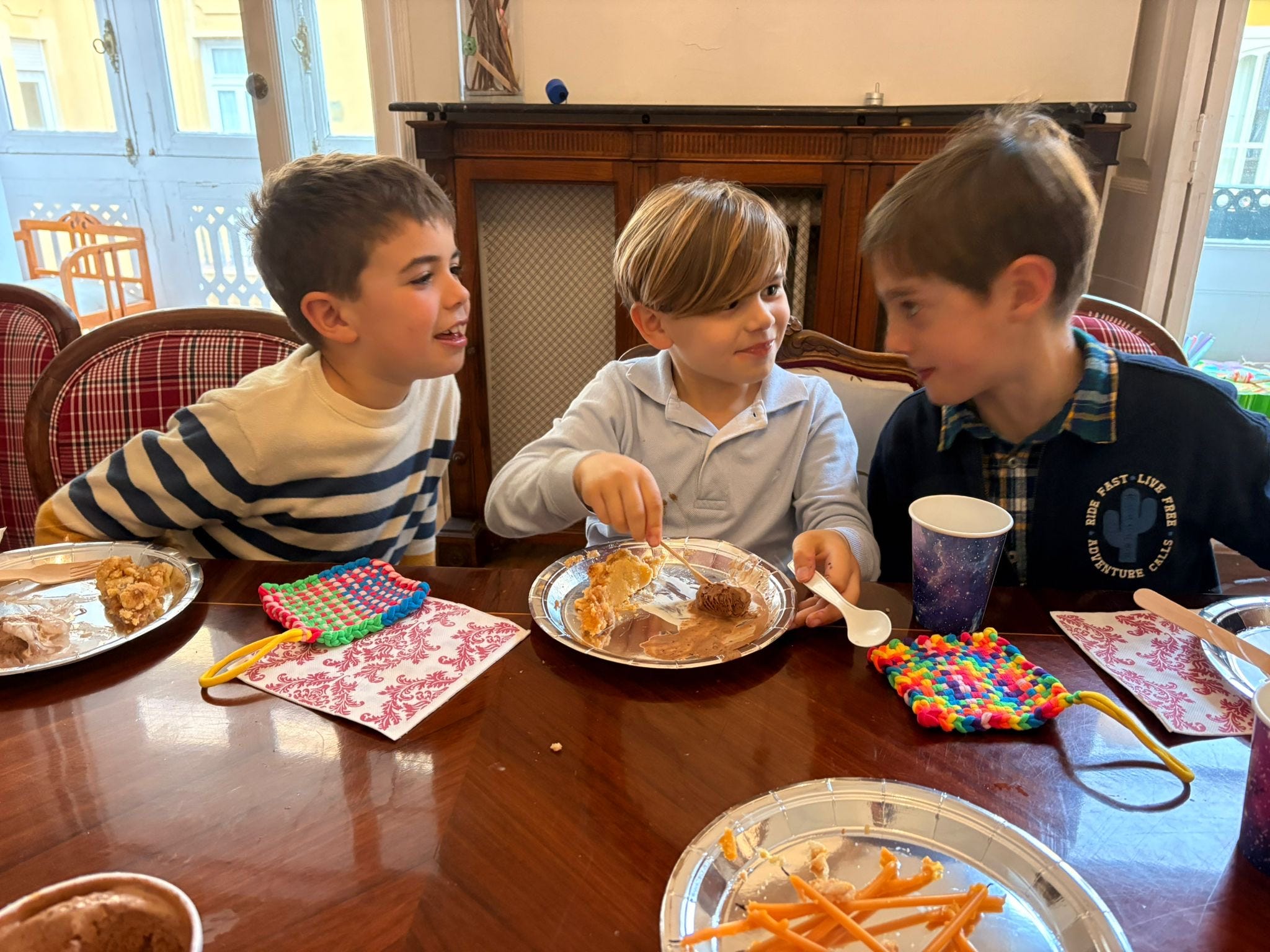
March 5, 2026 – At my son’s birthday party, I found myself having the same conversation I keep having with Ambitious Dads: “Work’s going well… but at home I overreact.” Not because we don’t love our kids, but because we’re carrying too much, too often: work, kids, relationships, health, logistics... On March 12, I’m hosting a free live workshop, Winning at Work Without Losing at Home. We’ll identify your Default Dad moments and start building the shift toward becoming a more intentional dad regardless of the season of life you and your family are in.
Every other Sunday, I try to do something that makes me feel responsible, modern, and vaguely employable.
I carve out a morning to explore new AI tools and trends. I poke around at new business models, scan what’s going to put me out of work, save prompts I’ll never open again, and tell myself: this is what staying relevant looks like.
Meanwhile, my son just turned nine and is leaning harder into friendships and listening less.
Not in a “bad kid” way but in a “new operating system” way. His peer orbit is getting stronger, and I see my role shifting, subtly. When a friend is in the room, my voice carries the authority of a low-battery notification.
So while I’m treating AI like a product that needs constant updates, I’m reacting to my son’s development as something I just “feel out” in real time.
Which is ironic, because I don’t feel calm about his development, I feel exposed. For whatever reason, I’m anxious enough to worry, but not oriented enough to study.
So I’m writing this post as a challenge to myself (and others): What if we tracked our kids’ development with even 20% of the curiosity and seriousness we bring to following AI / tech trends?
The Sunday Ritual (and the uncomfortable math)
AI makes it easy to feel behind. There’s always a new capability, a new tool, a new “everyone is using this now” moment. The fear is loud and immediate: If I don’t keep up, I’ll fall behind.
Childhood development doesn’t resonate in the same way.
I’m not getting push notifications on my phone that say:
• “Your 9-year-old just entered a new phase of friendship dynamics.”
• “Your influence is about to change.”
• “Emotional regulation is becoming more internal, less performative.”
• “Your kid is watching how you handle stress more than ever.”
Instead, I get new vibes. Shorter answers. Demotion to ‘ambient noise’ when friends enter the room.
Child development is gradual, emotional, and to state it plainly, threatens the thing we care about most: being enough.
So instead of researching, we default to what we know: work-mode.
I definitely try hard to lean in at home, but almost always find myself suggesting the same ways to engage with my boys that I have for the last 18 months.
KidOS (the operating system you actually need)
Our children are not “the same kid, but taller.”
They’re running new social, emotional, cognitive, and identity software every few years.
And if we don’t update how we lead, we end up parenting version 9.0 with a strategy built for version 6.0. And the main evidence of that is simply more friction with our children.
The point isn’t to become an expert in every stage. It’s to have a small set of questions we’re willing to stay curious about, on purpose. Because research does one magical thing for dads: It converts vague anxiety into specific attention.
We’re not avoiding research… we’re avoiding fear
We can pretend our avoidance of researching our child’s development stage is about time, but it’s not. We research AI because it’s a safe form of uncertainty. It’s external. It’s conceptual.
Kids are the opposite. Researching your child’s development forces you to confront questions like:
• What if I missed something already?
• What if the “window” is closing?
• What if their struggle becomes my regret?
• What if I can’t protect them from what’s coming?
As one Ambitious Dad shared with me, “this feeling of… what if I can’t protect him? What if somebody hurts him… there’s this fear of loss of control…and it really plays on my mind”
And when that fear gets big, we do what high-performing men often do:
We reach for control.
Which is exactly what Ambitious Dad Kelly Flanagan described on my podcast when he talked about feeling his nervous system activate and wanting to “take control of the situation.”
Not because he’s a controlling dad, but because control is what fear asks for when it doesn’t know what else to do.
The deeper point of this article isn’t “dads should research more.” It’s: dads need a new relationship with uncertainty at home.
The “intentionality pivot”: from reactive fatherhood to researched fatherhood
I get asked all the time on podcast interviews about what makes a good dad. My response is simple: many things make a dad good. But what makes a dad great is quite specific: being intentional. Intentional about how you show up, how you lead, and how you grow as a dad.
The point of research into our children’s development isn’t information. It’s presence. Research is how we choose to show respect for the season our kid is in.
And it’s how we avoid making our kid’s new phase feel like a problem we didn’t budget for.
The real upgrade: stop tracking “milestones” and start tracking needs
In the US, our focus (obsession) with childhood milestones can make us feel like we’re doing parenting “correctly,” while completely missing the human in front of us.
As Ambitious Dad Prakash Raman explained, “when any of our children’s milestones weren’t hit… we would be like, oh gosh, we’re worried about that.” Milestones became scorecards.
But if we zero in on milestone-checking, we often miss the deeper needs-based focus.
Instead of asking:
“What should a 9-year-old be doing?”
We ask:
“What does my 9-year-old need right now… socially, emotionally, and in our relationship?”
That’s a research question. And it’s a connection question.
A practical (non-psychotic) way to do this
Whether you have a Sunday AI, football, cleaning or pancake ritual, keep it. But also add a simple, 30-minute KidOS one to it. Once a month (or even once a quarter), pick one theme:
• friendships and belonging
• emotional regulation
• confidence and risk
• conflict and repair
• media and technology
• identity and self-concept
Then do three things:
Read one solid guide or article (not ten).
Ask one better question at dinner that week.
Notice one pattern without trying to fix it.
This is how we focus on needs over milestones. And the topics are squishy, for sure. This is not a science, but an art, and that can feel intimidating at first.
But reading and asking questions have a way of opening things up for everyone.
So now what?
You’re a father trying to love someone who is changing in real time, while you’re also changing in real time, with no universal manual, and very little cultural support for doing this thoughtfully.
Start where you are.
You don’t need to “catch up” to your child like it’s a race.
You just need one honest moment of curiosity that says:
Help me understand what’s changing for you… and what you need from me now.
That’s not optimization.
That’s love, wearing reading glasses.
I love this piece. Sometimes reading about parenting gets a bad rap - you see a lot of "just spend time with them, that's all you need". I'm convinced that's not true. I remember vividly educating myself as my eldest became a teenager, and my wife and learnt things we've implemented time and time again.
Jeff, I'm curious if you've found any AI tools you think are particularly useful, especially for dads!